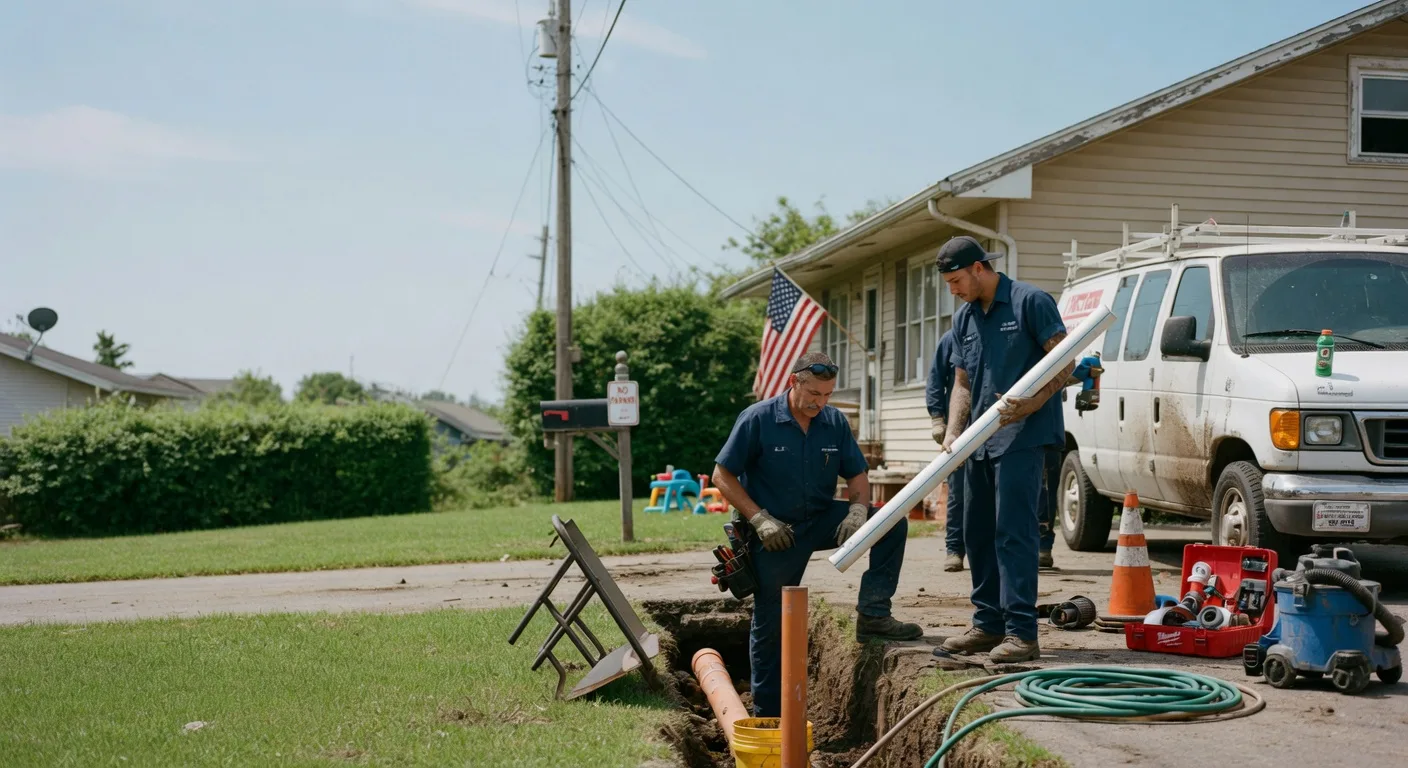
The street sewer backed up into my house. What is a backwater valve?
Sewage came up through the basement floor drain, or a low toilet or tub gurgled and overflowed, during a storm or a heavy-use evening.
The usual cause is the municipal main in the street filling past capacity, called surcharging. With nowhere to go, the flow pushes back up the lateral and out of the lowest opening in the house.
A backwater valve, also called a check valve, is a fitting on the lateral or building drain with a flap that lets waste leave and shuts when flow reverses. It sits on the line ahead of the branches serving the lowest fixtures.
Fitting one is not a quick swap. It usually means opening the floor or digging to reach the pipe. What it involves depends on access, the depth of the line, the valve and materials, how much has to be opened up and restored, and whether a permit or code sign-off is required. Rules vary by area.
A valve does not fix roots at a clay joint or a bellied line holding water. It only stops reverse flow. A private line problem needs a camera inspection first, then a cable machine or hydro jetting depending on what the camera shows.
Street or private? Ask three things. Are the neighbors affected? Did it coincide with heavy rain? Is only the lowest opening backing up while upper fixtures drain normally? Yes to those points to the street main. Only your house, in dry weather, points to your own lateral.
Safe homeowner check: look at the neighbors and the forecast. Stop running water now: no flushing, washer or dishwasher. Keep people and pets out of contaminated water, and call.
Expert Plumbers Co is a referral service. We connect you with an independent local plumber in Onley, VA. Call (380) 262-9173.
After the cleanup, ask how the valve will be kept working. The flap and its hinge can be stopped by lint, grease and grit, and then it no longer seats fully. Most valves have an access cover so the flap can be looked at and cleaned, and that should be done on a routine, not only after a storm. Learn where the cover is and keep boxes and floor coverings off it.
One point catches people out. With the valve closed during a storm, your own household water has nowhere to go either. Showers, sinks and the washer will fill the line behind the flap, so keep water use low until the street main drops.
After any backup, the floor drain and the area around it need to be cleaned and disinfected. Porous materials that soaked up sewage, such as carpet pad and cardboard, usually have to be removed rather than dried.
My bathroom sink drains slowly but the stopper is clean. What else could it be?
If you have pulled the stopper and cleaned off the hair and soap film and the sink still drains slowly, the restriction is further down. The stopper mechanism is only the first few inches. Most of the slowdown lives in the pivot rod area, the tailpiece, the trap, or the pipe beyond it.
The common cause is a layer of soap scum, toothpaste and hair that binds together on the pipe wall. It narrows the pipe a little each month, and the sink slows long before it stops.
Safe checks you can do: set a bucket under the sink and unscrew the trap. Clear out what you find and rinse it. Look at the short pipe going into the wall for build-up you can reach with a bottle brush. Fill the basin and let it run, then watch whether the water drains evenly or with a gurgle. Skip chemical cleaners, which can soften plastic fittings and leave caustic liquid sitting in the trap.
Gurgling is a clue. A sink that drains slowly and gurgles can point to a blocked vent, because the drain cannot pull air behind the water. If the toilet or shower near that sink also acts up, the blockage may be in the shared branch line or the main drain, not the sink itself.
One slow sink with everything else normal usually means a local clog, and a cable machine through the trap arm is enough. If the pipe clears and slows again within a few weeks, a camera inspection can show whether the pipe wall is scaled over or has a sag that holds water. Heavy scale or soap buildup in the branch line may call for hydro jetting.
Call and stop using the sink if you see water leaking from the trap or the wall, if sewage smells from the drain, or if several drains in the house slow at once. That pattern usually means the main line is partly blocked.
Cost depends on how easy the pipe is to reach, whether the cleanout is nearby, how far the plumber must run the cable, and whether any worn pipe has to be replaced.
Expert Plumbers Co can connect you with an independent local plumber in Onley, VA when you call (380) 262-9173.
Water or sewage is seeping out around the cleanout cap in my yard. What does that mean?
If liquid is seeping up around the cleanout cap, the sewer line is full to ground level at that point. The cleanout is a capped pipe that gives a plumber direct access to the main line, and it is often the lowest open point on the system. When a blockage sits downstream, waste water rises until it finds the weakest spot, and that is frequently the cap.
Less often the cap itself is the problem: a cracked cap or worn threads can weep a little after heavy use. The difference is the smell and the timing. A damp ring with no odor that dries out is one thing. Grey or dark water with a sewage smell that returns every time the house uses water points to a blocked or partly collapsed line.
Look at the rest of the house. If one fixture is slow, the trouble may be local. If several drains are slow, toilets gurgle, or a floor drain or shower fills when the washer runs, the main line is the likely culprit.
Safe checks you can do:
Keep children and pets away from the wet area. Hold off on laundry, dishwasher cycles and long showers. Do not unscrew the cap. A line under pressure can spray sewage when the cap comes off, and that is a health risk.
Stop running water and call now if sewage is reaching the yard in a steady flow, if it is entering the house, or if the seep keeps growing while you are using as little water as possible.
On the repair side, a cable machine is often enough for a soft blockage such as paper or grease. Roots, heavy grease build-up or scale usually call for hydro jetting or a cutting head. A camera inspection afterwards shows whether the pipe is cracked, bellied or offset at a joint, which decides whether cleaning will hold or whether a repair is needed. Cost depends on how easy the cleanout is to reach, how far the blockage sits from it, how much needs to be dug or removed if a repair follows, and permit requirements under local code.
If the line has to be opened for repair, the local building department may need to be involved. To be connected with an independent local plumber in Onley, VA, call Expert Plumbers Co on (380) 262-9173.
We are buying a house. Is a sewer camera inspection before closing worth it, and what does it find in older homes?
A standard home inspection covers what can be seen and reached. It does not follow the main drain out under the yard, and that buried pipe is where the expensive surprises sit. On an older house, a camera inspection of the sewer line before closing is usually worth doing.
A plumber feeds a small waterproof camera down the line, normally through a cleanout, and watches the pipe on a screen. The run goes from the house toward the street connection, and the plumber notes how far along each problem sits.
Here is what tends to turn up in older homes:
Tree roots in clay or concrete pipe, entering at joints. They look like fine hair or a thick mat.
Cast iron that has scaled up inside, narrowing the bore, or has cracked along the bottom.
Fiber pipe made of tar and wood pulp, which can go oval and collapse over time.
A bellied section, where the pipe has sagged and holds a pool of water.
Offset or separated joints where the soil has moved, and old broken sections from past digging.
Ask for the video or screenshots, and for the distance of each defect from the cleanout. That gives you something concrete to show your agent and the seller. A root problem that a cable machine or hydro jetting can clear is a very different matter from a collapsed section that needs digging or a trenchless liner. What a repair costs depends on depth, access, how much yard, driveway or slab has to be opened, the materials, and local permit rules. Those are the things to ask a plumber about once the footage is in hand.
Two practical points. First, find out whether the cleanout is reachable, and tell the seller you need access during your inspection window. Second, a camera cannot see through a line that is full of water or packed solid, so the plumber may need to clear it first. If the seller says the line has never given trouble, that is useful, but it does not show the condition of the pipe.
Ask also whether the lateral is shared with a neighbor, since that changes who deals with a defect.
Expert Plumbers Co can connect you with an independent plumber in Onley, VA for this: call (380) 262-9173.
My bathtub has a lever on the overflow plate and it drains slowly. Where is the clog?
Your tub has a lever on the overflow plate, the one you flip to close the drain, and now the water sits around your ankles. It drains slowly, and you want to know where the clog is. It is usually in one of two places.
Trip-lever drains have a plunger, or a stopper and linkage, that runs down inside the overflow tube behind that plate. A rod and spring connect the lever to the stopper at the bottom. Hair and soap scum wrap around that linkage and build into a mat that restricts the opening, even when the tub looks empty. If the linkage is out of adjustment, the stopper may also sit partly closed, so water slips through a narrower gap than it should.
The second place is the trap below the tub. Most tubs use a P-trap, and that bend collects hair, soap, and grease from bath oils. A clog there slows the whole tub even when the linkage is clean.
If only the tub is slow and the sink and toilet in the same bathroom work, the clog is almost certainly in the linkage or the trap. If the sink, shower and toilet also run slow, or the tub gurgles when another fixture drains, the problem is in the branch or main line.
Safe homeowner check: unscrew the overflow plate, pull out the linkage slowly, and clean off the hair and gunk. Check that the lever lifts the stopper fully. Run hot tap water, not boiling, to flush the drain. Avoid chemical openers.
Stop running water and call now if water backs up in the tub when the toilet or sink is used, if you see sewage, if there is water on the floor or ceiling below, or if a strong sewer smell shows up with the slow drain.
A cable machine is enough for a hair clog in the trap or a short branch. If the tub keeps slowing down, or several fixtures are involved, a camera inspection shows whether the cause is roots, a belly or grease coating the pipe. Hydro jetting is worth considering when the pipe wall is coated rather than plugged.
Expert Plumbers Co is a referral service. We connect you with an independent local plumber in Onley, VA. Call (380) 262-9173.
Ask the plumber whether the clog was in the linkage, the trap or further along, and whether the stopper needs replacing or adjusting. If the tub sits over a finished ceiling or is set in tile, ask how they plan to reach the trap. The scope depends on access, the parts or materials needed, how much has to be opened up, and any permit or code requirement.